WE SUPPORT CHARLIE RANGEL

Potomac Economics, the independent market monitor for the Regional Greenhouse Gas Initiative (RGGI) CO2 allowance market, today issued its 2009 Annual Report on the Market for RGGI CO2 Allowances. The report is based on data from the RGGI CO2 allowance auctions and data reported to the Commodity Futures Trading Commission (CFTC), the Chicago Climate Futures Exchange (CCFE) and the New York Mercantile Exchange (NYMEX).
The report is a part of Potomac Economics’s ongoing monitoring of the auction and secondary markets for RGGI CO2 allowances.
Previously issued reports from Potomac Economics
"Cooling Tower Heat Transfer 101"
By Brad Buecker
[Excerpts]
"Evaporation is utilized to its fullest extent in cooling towers, which are designed to expose the maximum transient water surface to the maximum flow of air – for the longest period of time.”1
For water to evaporate it must consume a large amount of energy to change state from a liquid to a gas.
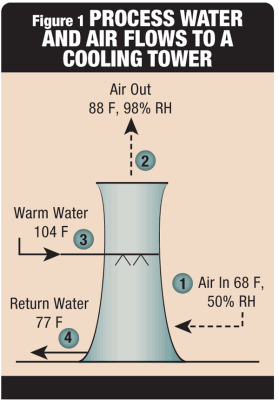 Figure 1 shows process conditions that could easily exist in a cooling system. We will calculate the mass flow rate of air needed to cool 150,000 gpm of tower inlet water to the desired temperature. We will also calculate the water lost by evaporation (go to link for full calculation). So, with an inlet cooling water flow rate of 150,000 gpm (1,251,000 lb/min), the calculated air flow is 1,248,000 lb/min, which, by chance in this case, is close to the cooling water flow rate. (Obviously, the air flow requirement would change significantly depending upon air temperature, inlet water temperature and flow rate, and other factors, and that is why cooling towers typically have multiple cells, often including fans that have adjustable speed control). The mass balance of water = 146,841 gpm. Thus, the water lost to evaporation is 3,159 gpm. A very interesting aspect of this calculation is that only about 2 percent evaporation is sufficient to provide so much cooling.
Center President Norris McDonald toured the Indian Point nuclear power plant for the third time on July 7, 2010. He also toured the plant in 2009 and in 2001. He is pictured below with other individuals touring the facility. The first photo [McDonald in middle] is inside the generation building and the second photo [McDonald in middle with shades] is just outside of one of the containment domes.


 Ten Northeastern states held carbon dioxide auctions selling credits for carbon emissions to electric utilities, who purchased the credits either to allow themselves to send carbon dioxide out the smokestacks of their own power plants, or to re-sell those credits to other utilities. The auction, a quarterly feature of North America's only working cap-and-trade regime for greenhouse gases, raised $80.5 million. The ten states have largely committed to promoting energy efficiency.
In the Regional Greenhouse Gas Initiative (RGGI) states agreed to use auction proceeds to reducing energy usage. Some states have redirected use of the money.
New Jersey's Global Warming Response Act said 80 percent of the money should go toward energy-related causes. New Hampshire lawmakers voted to take all of the state's expected $3.1 million share of the proceeds and use it to help plug a $295 million budget hole. New York transferred $90 million out of a fund of auction proceeds and into its general fund. And New Jersey is poised to use $65 million from carbon-credit sales to help balance its budget, pending a vote of the Legislature.
RGGI is a simple concept: States cap pollution, charge polluters to pollute, and put the money back into programs that conserve energy. The RGGI raids not only violate the states' original agreement with each other, but also upend the idea that cap-and-trade was supposed to save ratepayers money on their energy bills in the long run. It means cap-and-trade will cost money now instead of saving money.
The RGGI raids would seem to confirm the fears of critics: that cap and trade is a back door tax. With three states stashing extra auction proceeds in their general funds, there’s evidence to support the view that cap-and-trade regimes amount to just another tax.
RGGI held its first auction of carbon allowances in September 2008. Ten states now participate — Connecticut, Delaware, Maine, Maryland, Massachusetts, New Hampshire, New Jersey, New York, Rhode Island and Vermont. The auctions have raised a total of $663 million.
Although RGGI is a collaborative effort, it is ten different programs in ten different states. That’s one reason why the states have reached very different conclusions about whether or not to dip into their RGGI funds.
In Rhode Island, state law would prevents using the auction funds to fill a budget hole. In Maryland last year, lawmakers diverted RGGI money from energy-efficiency programs to helping low-income residents with their power bills.
In New York last December, Governor David Paterson proposed and the Legislature approved putting half of the state’s available RGGI money toward the general fund, even though state regulations called for it to be spent on energy efficiency.
New Jersey’s global warming law directs where the RGGI money is supposed to go. The catch there is that it’s not constitutionally dedicated, which allows the governor and lawmakers to raid it for budget purposes. Making the money constitutionally dedicated, which would be the next step in protecting RGGI money, requires a two-thirds vote by the Legislature and a ballot vote by state residents.
In New Hampshire, the RGGI money was legally dedicated to energy efficiency. That’s why the state Legislature had to vote for it to be spent toward the budget. (Stateline.org, 6/26/2010)
 Current Control Period Allowances Sold at $1.88
 RGGI CO2 AUCTIONS YIELD MILLIONS FOR INVESTMENT IN CLEAN ENERGY, JOB CREATION
  Medgar Evers College initiate this public service event, dubbed the Annual Environmental Issues Conference in March 1996. This conference has become an imporatnt venue for disseminating environmental information to the public and for environmental professionals to interact with students and community members. Today they focused on greening of the academic curriculum. The hope to demonstrate a link between a green inspired curriculum and a green economy.
"While we in the colleges are developing a green inspired curriculum we must safeguard against any perception of "green" as yet another gimmick. The curriculum must stress the real-world connection of green with healthier communities, more energy efficient homes and environmental sustainability."McDonald was introduced by Michael G. Flanigan, Development Manager, External Relations MEC. Drs. Wilber Hope and Mohsin Patwary presented awards. The afternoon session inluded panesl on Environmental Sustainability, Green Initiatives, and Science Panel.
 New York University today released its Climate Action Plan (CAP), a comprehensive approach to reducing the University’s carbon footprint and enhancing its overall sustainability. NYU’s CAP details the University’s current greenhouse gas inventory, lays out specific and effective projects to mitigate these emissions using current fiscally sound technologies while maintaining NYU’s vital teaching, learning, and research missions.
 Now You Can Reduce, Renew & Recycle While You Relocate!
iMoveGREEN, the country’s only moving company in EPA's Green Power Partnership is open for business this week. The sister endeavor to iStoreGreen launched successfully in 2008, iMoveGREEN employs eco-friendly systems, materials and programs that aim to avoid excesses, while efficiently and affordably executing relocations. A promising and progressive evolution of veteran moving company, Meyer’s Moving & Storage, iMoveGREEN repurposes the organization’s 25 year industry experience; converting it for the “conservational” era with intentions of hope and humanity.
So what makes a moving company green …? Beyond offering its customers biodegradable packing materials and reusable plastic boxes for transport, the iMoveGREEN business facility is appropriately powered by 100% renewable wind energy; drastically decreasing company fossil fuel use. Proving further environmentally conscience, the corporation adheres to an eco-friendly cleaning code, by which company vehicles are washed solely with recycled water and entirely green washing supplies; keeping chemicals from infiltrating the air. All surveyors drive a hybrid Toyota Prius, and an advanced recycling initiative is underway for the renewal of discarded moving materials and office waste.
The Nature Conservancy and iMoveGREEN have created a partnership where a percentage of proceeds from each move are allocated to the planting of trees in the Brazilian rainforest. Next are the “Green education” programs established to edify employees; further offering them wholesale rates on the purchase of eco-friendly items like CFL and LED light bulbs, recycled paper towels, coffee mugs and green cleaning products.
A Green Starter Kit is presented to each new customer; inclusive of a reusable tote, coffee mug, green-living brochure and housewarming plant. In efforts to ensure service is as good as it is green, the kit contains a client satisfaction survey, for which every one returned means an additional tree is planted in the Brazilian Rainforest. Such surveys and all additional marketing materials are printed on recycled paper using strictly soy ink.
iMoveGREEN is an EPA certified, fully-licensed and insured moving company specializing in domestic and international relocations, trade-show transport, office moves and more. The organization exhibits seasonally at New York’s GoGreenExpo. The home office of iMoveGREEN is 370 Concord Avenue, Bronx NY.
Norris McDonald, Martin Cook, Carolyn Green, Frank Stewart The American Association of Blacks in Energy (AABE) and the Alliance of Black Professionals (ABP)
held an energy forum today at National Grid in Brooklyn, New York with the theme:
“Future of Northeast Energy – What is on the Horizon?”
Panelists included:
Lisa Crutchfield, National Grid
Martin Cook, National Grid
Carolyn Green, National Chair of AABE
Frank Stewart, National President of AABE
Moderator: Norris McDonald, President Center for Environment, Commerce & Energy, African American Environmentalist Association The forum was held in the Metrotech Auditorium and covered a broad array of electricity, energy and environmental issues facing the Northeast. Some questions considered included: Is there adequate electrical capacity to satisfy the needs of Northeastern states in the next few years? Will energy prices negatively affect the Northeast? How could pending carbon dioxide regulations affect the Northeast? What about the influence of the Regional Greenhouse Gas Initiative (RGGI) on a project 'low-carbon' future? Do you know of any policies that are being put into place to address energy efficiency and alternative technology marketing techniques? How are companies and organizations looking to address the "green divide" to make sure minority communities in the Northeast region are not being left behind? Many other questions were addressed during the forum.
Photo: Stephanie George. Renee McClure, Martin Cook, Norris McDonald, Jose Garcia (kneeling), Carolyn Green, Frank Stewart, Bill Suggs, Akil Friday
Your eligible appliance(s) must be purchased between February 12th through 21st, 2010 to qualify
 "New York’s Great Appliance Swap Out" website provides all the information you need in order to participate. This rebate program, administered by the New York State Energy Research and Development Authority (NYSERDA), is available to residential consumers replacing existing appliances of the same type with new ENERGY STAR® qualified appliances or High Efficiency ENERGY STAR appliances. A larger rebate will be granted to consumers who recycle their discarded appliances.
Two rebate options are offered under "New York’s Great Appliance Swap Out" Rebate Program. Please click on the links below to view all of the eligibility guidelines for each option:
Option 1 – Single Appliance Rebate (eligible appliances: ENERGY STAR refrigerators, freezers and clothes washers) and
Option 2 – Appliance Bundle Rebate (eligible appliances: High Efficiency ENERGY STAR refrigerators, clothes washers and dishwashers)
This rebate program was made possible thanks to grants issued by the U.S. Department of Energy (DOE) to States and Territories to provide American Recovery and Reinvestment Act (ARRA) funding to develop and implement Energy-Efficient Appliance Rebate Programs.
More information:
Fill out Rebate Application OnlineCheck the Status of your Rebate Application
 Participants at the Carbon Trading Summit will include executives from JP Morgan Chase, Goldman Sachs, Duke Energy and more. Hansen has criticized these companies, writing "they are spending enormous amounts of money to be sure that cap-and-trade is doctored to allow as much business-as-usual emissions to continue as long as possible."
SCHEDULE OF EVENTS:
** Presentation by journalist and climate activist Tina Gerhardt: "From COP 15 to Climate Justice Movement"
When: Monday, Jan 11, 7 pm - 9:00 pm
Where: Bluestockings Bookstore, 172 Allen St (between Houston & Delancey St)
** Press Event with JAMES HANSEN, renowned climate scientist.
Also featuring Cecil Corbin-Mark of WE ACT for Environmental Justice, Harlem community organizer; Charles Komanoff, Carbon Tax Center; and Father Paul Mayer, Climate Crisis Coalition, representing concerned members of the interfaith religious community.
When: Tuesday, Jan 12, noon
Where: Irish Hunger Memorial Park, Vesey St, 2 blocks west of West St
** Rally and protest action outside of the 2nd Annual Carbon Trading Summit (Embassy Suites Hotel)
When: Wednesday, Jan 13, noon
Where: Irish Hunger Memorial Park, Vesey St, 2 blocks west of West St
Two original paintings will be raffled off with the proceeds donated to MillionTreesNYC
Brooklyn, NY: Gallery House is proud to present “EARTH,” an environmentally themed group exhibition. This exhibition in both form and function is meant to celebrate and highlight the challenges our planet is currently facing. Two receptions will be held during which one original painting will be raffled off with the proceeds donated to MillionTreesNYC, a public-private initiative between the City of New York and New York Restoration Project to plant and care for one million trees across New York City by 2017. The gallery will be open by appointment from February 5th through March 12th.
What: Gallery House Presents “EARTH’”
When: Wednesday, February 10 & Thursday, February 25, 2010 from 7:30pm – 11:00pm
Where: Gallery House 272 Clinton Ave. Brooklyn NY, 11205
About Gallery House
Galley House is a Clinton Hill based organization dedicated to the sharing of ideas pressing our world today. Through our hosted reception, we aim to gather and communicate said ideas through art, music and other types of artistic expression.
About MillionTreesNYC
MillionTreesNYC is a citywide, public-private initiative with an ambitious goal: to plant and care for one million new trees across the City's five boroughs by 2017. By planting one million trees, New York City can increase its urban forest - our most valuable environmental asset made up of street trees, park trees, and trees on public, private and commercial land - by an astounding 20%, while achieving the many quality-of-life benefits that come with planting trees.
The New York City Department of Parks & Recreation (Parks) will plant 60% of the trees in parks, on streets, and in other public spaces. The other 40% - coordinated through New York Restoration Project (NYRP) – will be planted by private organizations, homeowners and community organizations. Parks and NYRP are working with community partners to assess tree planting opportunities on schoolyards, public housing campuses, health care facilities, business districts, commercial and residential developments, front yards and other private lands.
 John Herron, left, has been named president, CEO and chief nuclear officer of Entergy, effective 1 December. In his new role as chief nuclear officer of Entergy, he is responsible for the operation and management of 9 sites and 11 reactors at Entergy’s nuclear plants in Arkansas, Louisiana, Massachusetts, Michigan, Mississippi, New York and Vermont. In addition, Herron oversees Entergy’s management services for the Cooper Nuclear Station, owned by Nebraska Public Power District. Herron began his career in the Navy as an instructor at the Nuclear Submarine Prototype School. Herron also held top management roles with the Tennessee Valley Authority in top management roles at their Sequoyah and Browns Ferry nuclear plants. He excelled in subsequent roles at Vermont Yankee Nuclear Power Corporation and the Cooper Nuclear Station before joining Entergy in February 2001 as vice president, operations at Waterford 3 Nuclear Station in Taft, Louisiana.Entergy advanced Herron into roles in New York as the senior vice president of Indian Point Energy Center then as senior vice president for nuclear operations handling fleet management. He fills his new position created by the retirement of former CEO Mike Kansler.
 An updated version of the Motor Vehicle Emission Simulator (MOVES) model – MOVES2010 – is now available for use to estimate air pollution from cars, trucks, and other on-road mobile sources. The model can also calculate the emissions reduction benefits from a range of mobile source control strategies, such as inspection and maintenance programs and local fuel standards.
The vast majority of people are on fixed electricity meters, which simply measure how much electricity has been used. These are used by the utility company to calculate how much you owe them for the electricity you have consumed.
During the day there are peak times when many people are using a lot of electricity - for example, in the early evening when many lights, tv's, and computers are switched on, and ovens and kettles are being used to prepare meals. In the middle of the night demands drops right off.
 A smart meter offers two way communication between the utility company (electricity supplier) and the consumer. When demand is high (and therefore wholesale electricity prices are very expensive) the utility company can pass high costs onto the consumer. When demand is low (and therefore wholesale electricity prices are very cheap) the utility company can pass savings to the consumer. This motivates consumers to use electricity when demand is least so that they can save money.
This video shows the 'In Home Energy Display' by General Electric

 The Long Island Power Authority (LIPA) Board of Trustees has approved power purchase agreements (PPAs) with BP Solar and enXco Development Corporation, creating the state's largest source of solar power on Long Island. LIPA's Solar Energy Project will introduce approximately 50 megawatts (MW) of renewable energy generated on Long Island onto LIPA's electric grid. LIPA will enter into PPAs with BP Solar and enXco Development Corp. to provide 32 MW and 17 MW of energy, respectively.
